
Buy AWS Accounts With Credit — Compute You Can Actually Afford
Buy AWS accounts and Amazon AWS accounts for sale with credit already applied. Preloaded AWS credit from $1,000 to $100,000, in a fully verified account, in your inbox in about eight minutes. If a plain compute account would be cheaper for you, we will say so before you pay.
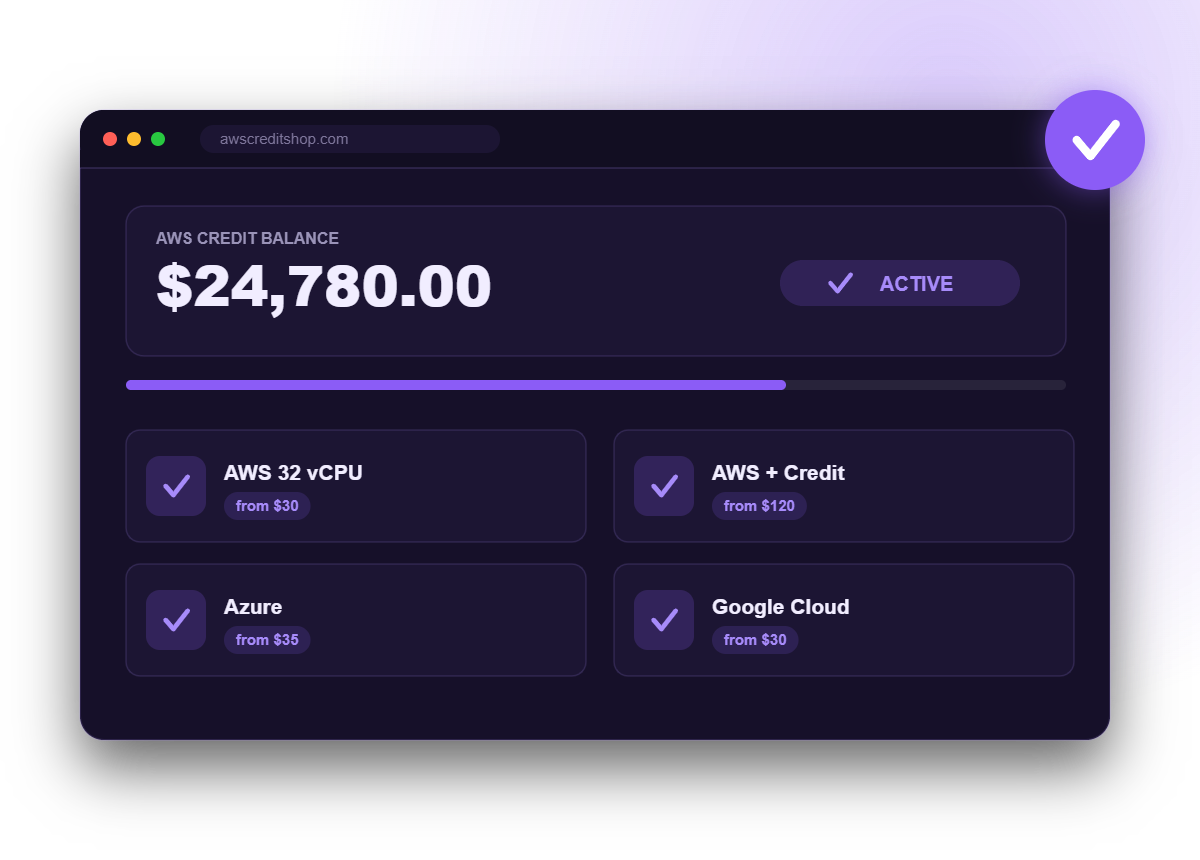
Credit, not just access
Most sellers raise your quota. We also lower your bill — which is the constraint that actually stops most AI and data teams.
Eight minutes, measured
Fulfilment is automated end to end. The median holds at 4am on a Sunday because nobody has to wake up.
Cleared before listing
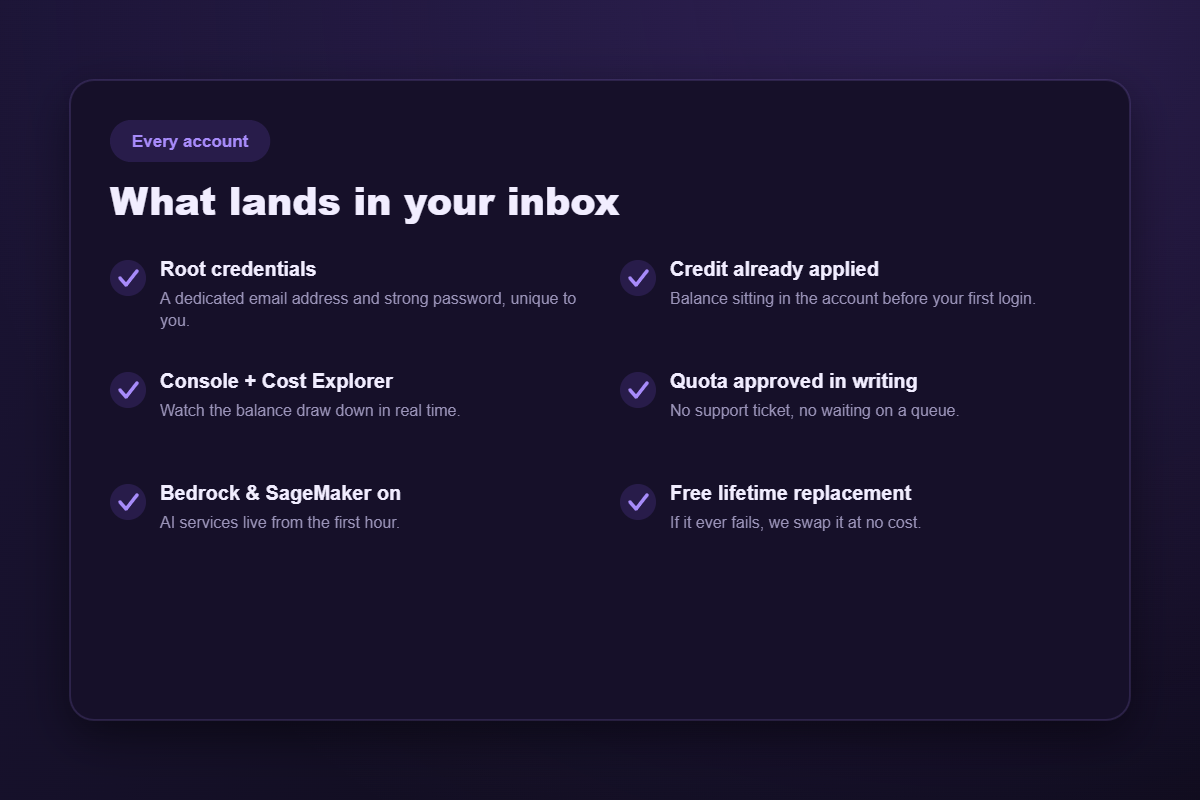
Identity and billing verification finished before an account is ever offered for sale. Nothing half-built ships.
We talk people down
If a $30 compute account beats a $499 credit tier for your workload, we tell you. Losing one sale beats losing a customer.
Buy AWS accounts with credit
A usable balance already applied to a verified account. You draw it down as you compute — instead of paying Amazon from a card.
Credit and accounts beyond AWS
Same verification, same guarantees, same honest advice about whether you need them at all.
Buy AWS Accounts With the Credit Already Applied
When you buy AWS accounts from AWSCreditShop, the credit is not a coupon you chase after signup — it is already on the account when it reaches you. Choose a balance from $1,000 to $100,000, and the preloaded AWS account lands in your inbox in minutes, verified and ready to spend.
These AWS accounts for sale also come as plain compute if credit is not what you need — 32 vCPU, 64 vCPU and 128 vCPU tiers — and the same instant delivery covers Azure, Google Cloud and more. Raise the ceiling with a bigger compute tier; lower the bill with credit.
The honest reason to buy Amazon AWS accounts with credit here is arithmetic: the account is cheap, but the compute you run on it is not, and a preloaded balance is what turns an ambitious training run from unaffordable into routine. Every account is sold once, verified before delivery, and backed by lifetime replacement.
Nobody is blocked by AWS. They are blocked by the invoice.
Almost every marketplace selling cloud accounts sells you the same thing: a higher ceiling. More vCPU, more concurrency, permission to run bigger machines. And for a lot of people that genuinely is the problem — a fresh account will not launch what they need, and a raised quota fixes it.
But if you are training models, running long analytics jobs, or rendering anything at scale, that is not your problem at all. Your account launches things perfectly well. What stops you is the number at the bottom of the bill.
That is the gap this shop exists to close. When you buy an AWS account with credit, you are not buying permission — you are buying the compute itself, at a discount, sitting in the account before you log in. It is a different product answering a different question, and conflating the two is the most expensive mistake in this category.
Not sure which of the two you actually have? This piece walks through it, and it will happily tell you to spend less.
How much AWS credit do you actually need?
Buy too little and you are back at the checkout in a month. Buy too much and you have prepaid for compute you will not consume before it expires. Neither is a bargain.
Start from your burn, not your ambition
The only number that matters is your realistic monthly AWS spend over the next six months. Not the spend you hope for once the product takes off — the spend you can defend today.
Take that figure, multiply by the number of months of runway you want, and buy the tier just above it. That is the entire method, and it beats every rule of thumb we have seen.
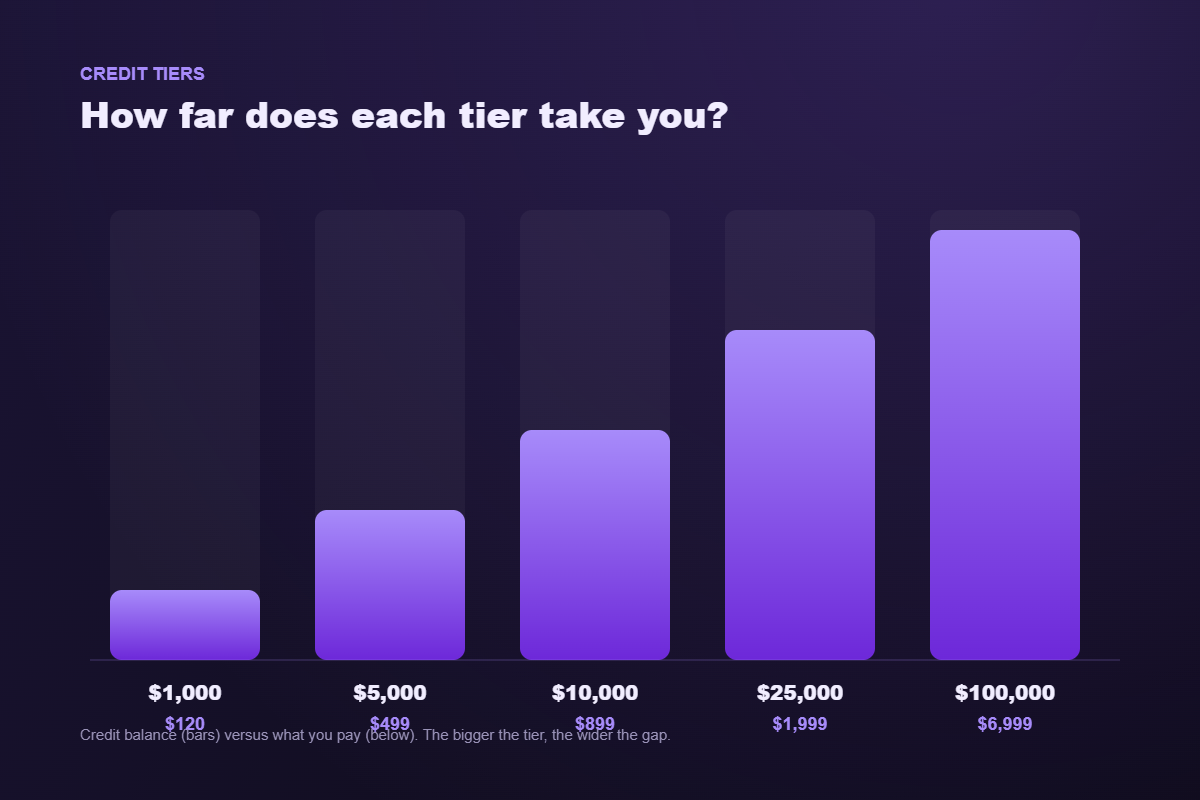
$1,000 – $5,000: experimentation
A first serious fine-tuning run, a proof of concept that needs real GPUs behind it, or a few months of a modest production stack. Most first-time credit buyers belong here and overshoot it.
$10,000 – $25,000: runway
Sustained training, continuous analytics, or a pre-revenue startup buying itself a year rather than a quarter. This is where the arithmetic gets genuinely compelling.
$100,000: an operating decision
At this level you are not buying credit, you are making a capacity commitment on behalf of a company. Do not do it on a hunch — talk to us, and expect us to ask you questions you may not enjoy.
The expiry trap nobody mentions
Credit carries a time horizon. A large balance you cannot consume before it lapses is not a saving; it is a donation. Ask us for the exact terms on your tier before you pay, and be honest with yourself about your burn rate. We would rather sell you $5,000 you will use than $25,000 you will not.
When to buy no credit at all
If your infrastructure will cost $40–$80 a month, skip this entirely. Buy the 32 vCPU account at $30 and pay AWS the small bill as it arrives. We say this weekly and lose the larger sale every time. More on making credit last here.
The mechanism, without the mystique
There is no clever trick here and we are not going to pretend there is. A credit account arrives with a usable balance already applied. As you consume compute, you draw that balance down instead of paying Amazon directly from a card. When it runs out, you are back to paying normally.
That is it. The value is simply that the balance costs you less than the compute it buys — and the larger the tier, the wider that gap becomes.
What it does not do is raise your service quota. If your instances will not launch, credit will not help you; you need a higher vCPU tier instead. Plenty of AI teams need both, and buy both. Everyone else should buy exactly one and know which.
Anyone selling you credit while implying it also solves concurrency is either confused or hoping you are. Here is how quotas actually work.
From checkout to a live balance in about eight minutes
Fulfilment is fully automated, which is the only honest way to promise a number. It does not degrade at night or at weekends, because there is no human in the chain to be asleep.
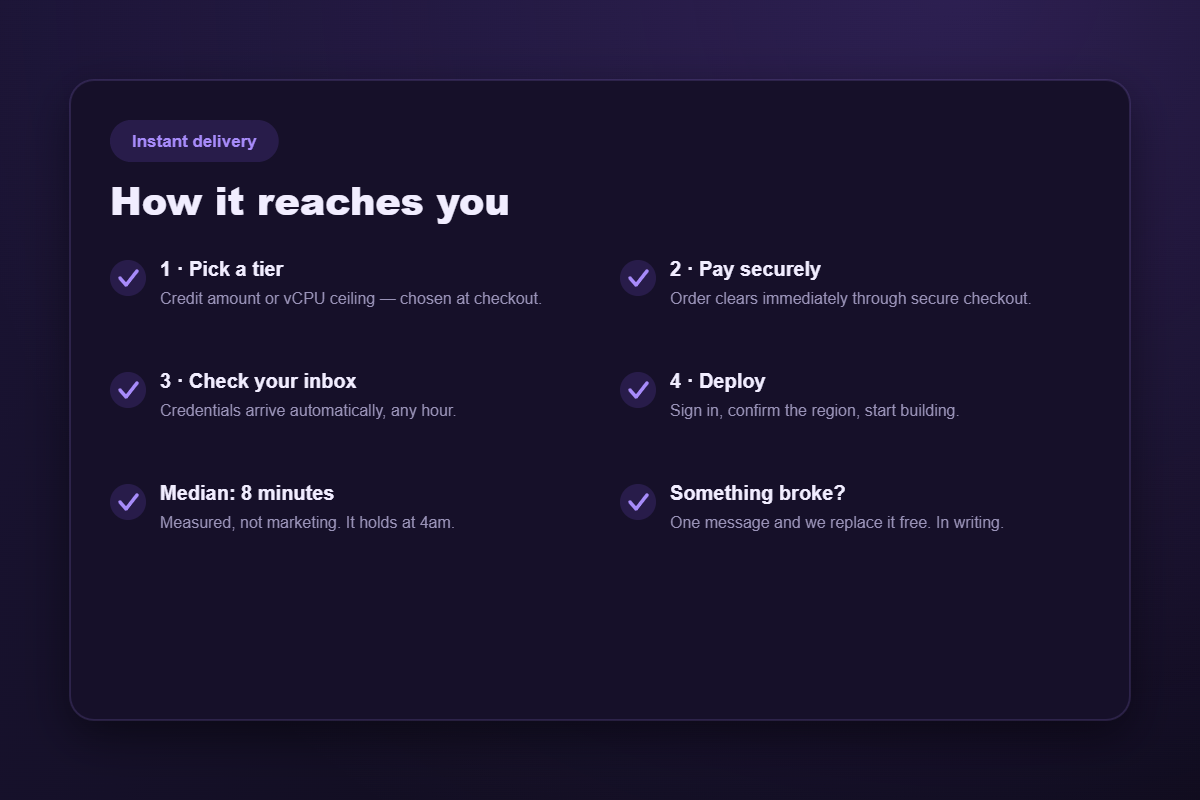
Occasionally something fails after handover. Cloud platforms are not deterministic and we will not pretend otherwise. What we commit to is the response: one message to support and the account is replaced free of charge. That is a written term of every order, not a courtesy we might extend if we happen to like you.
Is buying AWS credit safe?
The honest answer is that the concept is not the risk — the counterparty is. And in the credit market specifically, the failure modes are uglier than elsewhere, because the amounts are larger and the balance is harder to verify before you have paid.
Bad sellers in this niche share a profile. They will not tell you the expiry terms. They cannot show you the balance before purchase. Their support evaporates the moment money moves. And they will happily sell a $25,000 tier to someone running a WordPress site, because nobody has ever lost a sale by agreeing with the customer.
Hold us to the opposite standard. Ask for the expiry terms on your tier — we will give them to you in writing before you pay. Ask a hard question and time our reply; that costs you nothing and tells you more than any review page. And notice how often, on this very page, we have tried to sell you something cheaper.
We are an independent reseller with no affiliation to Amazon Web Services. Buying credit saves you money; it does not transfer responsibility. You remain accountable for operating within the platform’s terms of service and for whatever you run.
Credit and accounts for every major cloud
And a standing offer to talk you out of the expensive one.
If you are inside the Microsoft ecosystem, or you specifically need Azure OpenAI, an Azure account removes friction AWS never will. If your work is data-heavy and Kubernetes-native, Google Cloud — BigQuery, Vertex AI — is genuinely the better home, and credit works the same way there.
But here is the part a credit shop has every incentive to leave out: if your workload is a web app, an API, a database and some workers, you do not need credit and you probably do not need a hyperscaler. Hetzner, DigitalOcean or Linode will run it for a fraction of the price, and there is no bill large enough to need discounting.
Oracle Cloud deserves a mention for its unusually generous always-free ARM tier — an excellent place to prototype before committing money anywhere, including here.
Every platform in our cloud accounts range carries identical terms: verified before sale, delivered in minutes, replaced free for life. If you are genuinely torn between two, this comparison lays out the trade-offs, or describe what you are building and we will name the one we would pick — including when that costs us the sale.
Teams where the bill is the bottleneck
AI & ML teams
Long GPU-heavy training runs where the cost scales with ambition. The clearest case for credit, and the least ambiguous arithmetic. Pair it with a 128 vCPU account if concurrency also bites.
Data teams
Continuous pipelines and large queries that accumulate cost quietly and relentlessly — exactly the spending shape credit absorbs well.
Pre-revenue startups
When runway is the only metric and infrastructure is a real line item, converting a fixed payment into months of compute is simply rational.
Want to know who you are buying from? Read our story, or dig through the blog.
Questions people actually ask
Is the credit real, and can I see it?
It is applied to the account before delivery and visible in the AWS billing console the moment you first sign in. If it is not there, that is a replacement case and we act on it immediately rather than debating it with you.
When does AWS credit expire?
Credit carries a time horizon and the terms differ by tier. Ask us for the exact expiry on the tier you are considering before you pay, and we will put it in writing. A balance you cannot consume in time is not a discount — it is a loss, and we would rather lose the sale than sell you one.
Does credit raise my vCPU quota?
No, and this is the single most common misunderstanding. Credit lowers what you pay. Quota governs what you may run at once. If your instances refuse to launch, you have a quota problem and you need a higher compute tier, not credit. Many AI teams need both and buy both.
Can I use credit for GPU instances?
Yes — and for most credit buyers that is the entire point. Availability of specific GPU instance types varies by region, so tell us what you intend to run before ordering and we will make sure the account is set up in a region where it exists.
What happens when the credit runs out?
Billing reverts to the payment method on the account, exactly as it would on any AWS account. Nothing breaks and nothing shuts off unexpectedly — but you should set a billing alarm at 50% and 80% of balance so the transition is not a surprise. We wrote a guide on making credit last.
How fast is delivery, honestly?
Our median is about eight minutes from cleared payment to a working console with the balance showing. That is a measured figure, not a marketing one, and it holds overnight and at weekends because fulfilment is automated.
What if I bought the wrong tier?
Talk to us before you buy and this will not happen. Describe the workload, tell us your realistic monthly burn, and we will name the tier — including the version where the honest answer is a $30 compute account and no credit at all.
Do you sell credit for other clouds?
Yes — Azure and Google Cloud both carry credit tiers on the same terms. See the full cloud accounts range.
Buy the compute, not the permission
Preloaded AWS credit in a verified account, in your inbox in about eight minutes. And an honest answer if you do not need it.
Buying AWS accounts: common questions
Where can I buy AWS accounts with credit safely?
You can buy AWS accounts with credit safely at AWSCreditShop. The balance is applied before delivery and visible at first login, each account is sold once and verified, and the credit expiry is stated in writing before you pay. Accounts are backed by lifetime replacement.
Are these Amazon AWS accounts for sale delivered instantly?
Most orders arrive within minutes and at most a few hours, because each account is checked by hand before it ships. Your verified Amazon AWS account arrives with the credit balance already applied and ready to use.